Saturday, January 23, 2010
Too firm, too soft, just right
Back in America, the most common question people asked me when they learned I had agreed to teach in sub-Saharan Africa for a year was, "why do you want to do that?"
I knew I had the answer somewhere inside. I felt it. But I could never grasp what that answer was. Something about perspective, understanding, experience, empathy, humanity, affluence, opportunity. I just couldn't organize that feeling and those ideas into a coherent thought. I still couldn't until tonight, when I watched this:


By a Thread
About a month ago I entered the local landline telephone company  (Vodafone) offices in Tema to sign up for broadband Internet. It turns out the principles of economics hold true in Ghana just as they do in the US: monopoly companies are no less inefficient here than they are at home (be reminded of the cable company, the phone company, the DMV office, etc...). After a few visits to the office and a cumulative couple hours waiting in "ques" I had finally managed to pay Vodafone 126-cidi (About $90). This covered installation of a phone line ($4), installation of my broadband ($40) - a service that I could have performed since it just meant connecting a modem to the phone line and configuring it through my computer, and the first month of service ($46). Then I waited for the whole installation process to begin. And I waited. And waited. At one point a Vodafone truck pulled up and I excitedly greeted them. They looked at my house and said, "you don't have a phone line." I told them that I knew that and that I had paid $4 at the office to have one installed. They were surprised that the "phone line installer guy" hadn't already been to my house and then they started to leave. I stopped them (with the same urgency Tom Hanks would have stopped a wayward vessel whose captain had realized he was in the wrong place and started to sail away from the deserted island) and begged "can't you call the 'phone line installer guy' and have him come right now?" They told me that they would. Then they left.
A week later I went back to Vodafone's offices, waited in the que, met with an agent, and was told the installer would be to my house the next day - New Years Day. Fortunately the new year arrived. Unfortunately the installer did not. A week later (after getting out of the hospital) I received a call from an installer - he was coming by. I told him I would be here. Three hours later I called him back. He said he was on his way, and then asked me where I lived (?!?!?). Finally he appeared. An hour later I had a phone line entering my house (I didn't even mind that they had installed it by poking a hole in my window screen and feeding it through). Then the "phone line installer guy" started to install the modem. Watching him fumble with my laptop I quickly realized that he did not also hold the title of "broadband installer guy." I offered a few suggestions, he obliged. Then in desperation he called someone on his cell - probably the "broadband installer guy" - and was talked through the procedure. I had internet in my house!!!
Two hours later it stopped working. I figured it was something with the service provider so I waited until the next morning. When it still wasn't working I called customer service. The lady told me there was a system-wide problem and they were working to fix it (hey, the water goes off about once every three days and the power goes out every other week, so why not the Internet too?). The next day I got the same explanation. And the next day. Finally I asked them to explain the problem a bit more. She referred me to tech support.
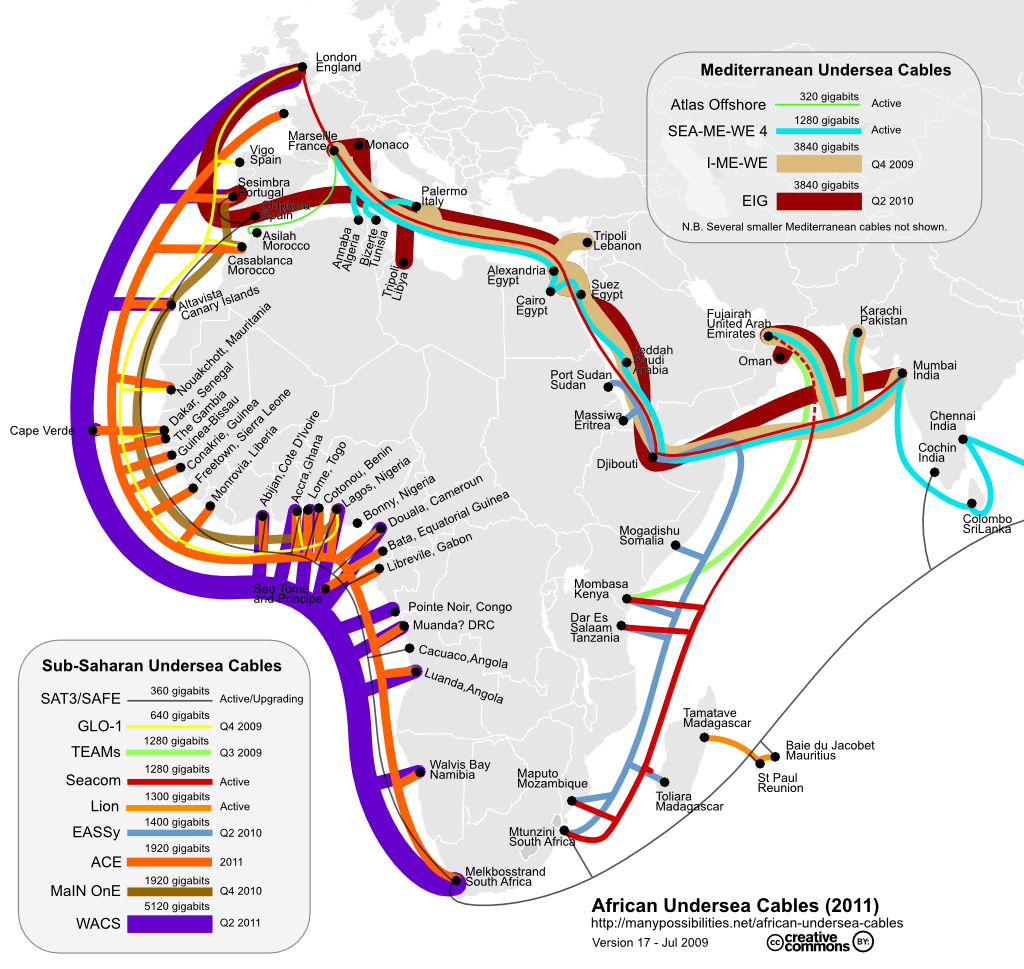
Tech support told me there had been a break in the undersea cable that connects west Africa to Portugal. (now aka "The Lifeline"), but he told me it had been repaired a day ago! So he talked me through changing some of my settings (the ones set by the "phone line installer guy" while posing as a "broadband installer guy") everything was back on (I wonder how long customer service was going to keep telling me there was a system-wide problem?).
For a week I had beautiful, though slow, broadband (it's 512kbs for those of you who speak techtalk - about half the speed of the slowest broadband you'll find in the US). Then it stopped working again. I waited until the next day and called - not customer service, this time I went straight to tech support. They had a recorded message referring to another undersea cable break and stating that they had a submarine crew working on it. Wow! A submarine crew! Images from The Abyss flashed in my mind. Each day I called and got the same message. Four days later the message was gone and I reached a person. The cable had been fixed. By my service was still off. The agent on the phone looked up my account and said there was nothing she could do, I would have to go to the office. I said okay, and then asked if she could change my email address that they had on file (I noticed on a form that they had typed it incorrectly "Sducate4peace"). She told me I would have to go to the office for that too (I wonder, what can the person on the phone do?).
Once at the office I explained my problem. The woman wasn't sure why my service was off. I told her I wasn't either, and neither was the person on the phone. She said there's another woman in the office whose job it is to investigate such matters, but that she was out this day. I was told to write a letter explaining the problem. She then handed me a blank sheet of computer paper and said, "this is for your letter."
I tried to make it look as official as a hand written letter on a blank sheet of paper can look - I put a date at the top, addressed it "To Whom it May Concern:" and ended with my signature, my printed name, my account number and my contact number. The woman took my letter and seemed very impressed. :-)
I told her I really need my internet though. She said I could pay another $46 and she could activate it (but she can't tell me why it had been deactivated?). So, I grudgingly took out some bills and paid the lady. I asked how long it would take for the service to resume. She said, "oh, it's on right now."
__________________
I am sure some people will interpret this post as being critical or overly-negative. But truthfully I tend to handle these things with a smile and a shrug of the shoulders. I simply wish to illustrate for my American readers the type of day-to-day experiences common to everyone living beyond the "wealthy" world. The real take-away from this is not that I am having a difficult or frustrating time, I am not. Rather, consider the impact that poor infrastructure - including cracked, pothole filled roads; few sources of electricity; aging water lines; and open sewers - has on those who are striving to set up or expand businesses in Ghana and across the region, providing desperately needed jobs to many.
I know that my time here is temporary and in the end, I will return to my country, the United States - to the world of never-ending potable water, perfect roads (yes, perfect - I challenge any American to complain to a Ghanaian about American roads), 24-hour grocery stores, gas stations that pump cheap gas on every corner, and health services unlike anywhere else in the world. However Ghanaians don't have that luxury. This is their country. And they love their country, as they should. They want to see it improve, to join the list of nations that seem to "matter." They work hard, study hard, strive for success, put their family and religious beliefs first, and are unfailingly hospitable and generous with the relatively little that they have. Their optimism and selflessness are an example Americans should learn from. And yet they are, in so many ways, hanging on by a thread.
 (Vodafone) offices in Tema to sign up for broadband Internet. It turns out the principles of economics hold true in Ghana just as they do in the US: monopoly companies are no less inefficient here than they are at home (be reminded of the cable company, the phone company, the DMV office, etc...). After a few visits to the office and a cumulative couple hours waiting in "ques" I had finally managed to pay Vodafone 126-cidi (About $90). This covered installation of a phone line ($4), installation of my broadband ($40) - a service that I could have performed since it just meant connecting a modem to the phone line and configuring it through my computer, and the first month of service ($46). Then I waited for the whole installation process to begin. And I waited. And waited. At one point a Vodafone truck pulled up and I excitedly greeted them. They looked at my house and said, "you don't have a phone line." I told them that I knew that and that I had paid $4 at the office to have one installed. They were surprised that the "phone line installer guy" hadn't already been to my house and then they started to leave. I stopped them (with the same urgency Tom Hanks would have stopped a wayward vessel whose captain had realized he was in the wrong place and started to sail away from the deserted island) and begged "can't you call the 'phone line installer guy' and have him come right now?" They told me that they would. Then they left.
A week later I went back to Vodafone's offices, waited in the que, met with an agent, and was told the installer would be to my house the next day - New Years Day. Fortunately the new year arrived. Unfortunately the installer did not. A week later (after getting out of the hospital) I received a call from an installer - he was coming by. I told him I would be here. Three hours later I called him back. He said he was on his way, and then asked me where I lived (?!?!?). Finally he appeared. An hour later I had a phone line entering my house (I didn't even mind that they had installed it by poking a hole in my window screen and feeding it through). Then the "phone line installer guy" started to install the modem. Watching him fumble with my laptop I quickly realized that he did not also hold the title of "broadband installer guy." I offered a few suggestions, he obliged. Then in desperation he called someone on his cell - probably the "broadband installer guy" - and was talked through the procedure. I had internet in my house!!!
Two hours later it stopped working. I figured it was something with the service provider so I waited until the next morning. When it still wasn't working I called customer service. The lady told me there was a system-wide problem and they were working to fix it (hey, the water goes off about once every three days and the power goes out every other week, so why not the Internet too?). The next day I got the same explanation. And the next day. Finally I asked them to explain the problem a bit more. She referred me to tech support.
Tech support told me there had been a break in the undersea cable that connects west Africa to Portugal. (now aka "The Lifeline"), but he told me it had been repaired a day ago!
 So he talked me through changing some of my settings (the ones set by the "phone line installer guy" while posing as a "broadband installer guy") everything was back on (I wonder how long customer service was going to keep telling me there was a system-wide problem?).
For a week I had beautiful, though slow, broadband (it's 512kbs for those of you who speak techtalk - about half the speed of the slowest broadband you'll find in the US). Then it stopped working again. I waited until the next day and called - not customer service, this time I went straight to tech support. They had a recorded message referring to another undersea cable break and stating that they had a submarine crew working on it. Wow! A submarine crew! Images from The Abyss flashed in my mind. Each day I called and got the same message. Four days later the message was gone and I reached a person. The cable had been fixed. By my service was still off. The agent on the phone looked up my account and said there was nothing she could do, I would have to go to the office. I said okay, and then asked if she could change my email address that they had on file (I noticed on a form that they had typed it incorrectly "Sducate4peace"). She told me I would have to go to the office for that too (I wonder, what can the person on the phone do?).
Once at the office I explained my problem. The woman wasn't sure why my service was off. I told her I wasn't either, and neither was the person on the phone. She said there's another woman in the office whose job it is to investigate such matters, but that she was out this day. I was told to write a letter explaining the problem. She then handed me a blank sheet of computer paper and said, "this is for your letter."
I tried to make it look as official as a hand written letter on a blank sheet of paper can look - I put a date at the top, addressed it "To Whom it May Concern:" and ended with my signature, my printed name, my account number and my contact number. The woman took my letter and seemed very impressed. :-)
I told her I really need my internet though. She said I could pay another $46 and she could activate it (but she can't tell me why it had been deactivated?). So, I grudgingly took out some bills and paid the lady. I asked how long it would take for the service to resume. She said, "oh, it's on right now."
__________________
I am sure some people will interpret this post as being critical or overly-negative. But truthfully I tend to handle these things with a smile and a shrug of the shoulders. I simply wish to illustrate for my American readers the type of day-to-day experiences common to everyone living beyond the "wealthy" world. The real take-away from this is not that I am having a difficult or frustrating time, I am not. Rather, consider the impact that poor infrastructure - including cracked, pothole filled roads; few sources of electricity; aging water lines; and open sewers - has on those who are striving to set up or expand businesses in Ghana and across the region, providing desperately needed jobs to many.
I know that my time here is temporary and in the end, I will return to my country, the United States - to the world of never-ending potable water, perfect roads (yes, perfect - I challenge any American to complain to a Ghanaian about American roads), 24-hour grocery stores, gas stations that pump cheap gas on every corner, and health services unlike anywhere else in the world. However Ghanaians don't have that luxury. This is their country. And they love their country, as they should. They want to see it improve, to join the list of nations that seem to "matter." They work hard, study hard, strive for success, put their family and religious beliefs first, and are unfailingly hospitable and generous with the relatively little that they have. Their optimism and selflessness are an example Americans should learn from. And yet they are, in so many ways, hanging on by a thread.
Perspective
Every year on the first day of school I have my students give me some information about themselves by completing what I call a “get to know you” card. Each student is given a 3x5” note card and specific instructions what to write on it. This practice is pretty common among American teachers, but I’m pretty sure this was a new experience for my students in Ghana this week.
Beyond the routine questions such as the student’s name, birthday, home town, and their plans after high school, I also asked the students to list three positive characteristics about Ghana (since, as I told them, “I’m new to your country so what good things would you like me to know”). In addition, I asked them to list two or three ideas about the US that they have heard but aren’t sure if they are true.
Here are their unedited responses (the number in parenthesis is the number if times that answer was given):
Ghana’s Positive Characteristics:
(28) Ghana is a peaceful country
(17) Ghanaians are hospitable
(17) Ghana has a lot of tourist attractions
(6) Ghana is a hardworking country
(5) The beautiful cultural heritage
(4) Ghanaians are sociable
(3) The people are very kind and generous
(3) We are patriotic
(2) Ghana has a lot of mineral deposit (natural resources)
(2) We have good resources such as gold, timber, cocoa
(2) The people are loving and caring
(2) Ghana is a democratic country
(2) There is national cohesion
(2) Ghanaians are God fearing
(2) Education
There are a lot of factories and industries for production of goods
War does not happen as another country
Ghana is tolerant
Ghanaians are being respected and accepted by other states
In Ghana a citizen has much freedom to do whatever he or she wants to do
There is always food
Ghanaians are peaceful, hospitable, great
Ghana is full of joy
There is no constraint in being a christian
They like investing a greater part of their income in education
Lovely people
We are kind-hearted
Ghana is a united nation, we all see each other as our brothers and sisters
Ghana is a lovely country to be
Ghanaians are well mannered
I like Ghana, because of the friendly nature of talking to people
Ghana is always neat
Ghanaians abide by the rules of the country
Ghanaians love people across the world
Peace, love, and freedom
What do you think you know, or wish to know, about the USA?
1. US has no respect for Africans.
2. Is it true that parents open bank account for their children?
3. Students use a lot electronic devices in their studies.
4. The students normally use computers for learning which makes it very easy for studies.
5. Can you be mentally or physically disabled and be in USA when not a citizen?
6. Do students lack respect for teachers
7. Is it true that the government feeds and cater for children till their old enough?
8. Is it true that one could be stabbed with a knife if caused by harm by a gang of guys on the street?
9. Is it also true that before you buy a knife you must bring your passport?
10. Is it true that there are a lot of jobs in America?
11. Is America a peaceful country like Ghana?
12. Is it true that Americans don’t treat Ghanaian students and workers well?
13. Is it true that most American artiste are Satanist?
14. Is it true that thousands of people are loosing their jobs yearly?
15. Africans are not recognised
16. Children under 4 years are being paid
17. There is so much work
18. How do their kids behave since they are not beaten
19. Can the government of the United State of America build a house for you, when you were born there, and also pay your school fees for you?
20. Is it true that blacks are not given some kind of opportunities?
21. Is America all about all about drugs and arms utilization in High School?
22. Do you get paid when you’re in the university?
23. Is there a lot of discrimination in the schools in America if you’re an African?
24. Do American students mock the blacks. Those from African countries.
25. In which city or state is NASA situated?
26. What is the growth rate of the USA?
27. Is America the richest country?
28. Is President Obama the last president to rule America ever?
29. Is it true that most of the Americans musicians worship satan?
30. Do they take (eat) our local foods? Like banku.
31. Are the people very kind or wicked?
32. Are they generous like we are?
33. Are there homeless people in America?
34. How do you cope when the weather is extremely cold?
35. Are most Americans lesbians and gays?
36. Do all American students get to go to college?
37. How do the student in the US cope with their teachers?
38. I heard that President Obama is the last president to rule the country and after that there will be judgement day. Is that true?
39. Do Americans always change their car every year?
40. Does Americans use credit cards? And how do you fill it?
41. Is it true that there are Satanist churches there?
42. Do parents allow their children to go to night clubs?
43. Do most Americans think that Africa is jungle?
44. Is it true that at some point of the year you have 24 hours of darkness?
45. Do you have poor people in America?
46. Are things expensive there?
47. Is it true that children express themselves freely to their parents even if it shows disrespect?
48. How high is the level of HIV/AIDS in the States?
49. Is it true that in American schools questions are given to students to learn before their exams?
50. Does America make ammunition just to fight the middle east?
51. Why is it that your country improve very well in technology?
52. I will have to know the benefit you gain from lending money to other country
53. Is it true that streets of America are not safe at night?
54. During the winter season do some people get frozen?
55. Do American children talk ridiculously to their parents and nothing is done about it?
56. Is it true that the children are greatly educated on sex?
57. Is true in America their learning process is through the Internet?
58. Is it true that at the age of 16, parents give their children the freedom to do things, such as getting into a relationship and introducing their boyfriend or girlfriend to their parents?
59. Is it true that a child can sue his or her parent in court for beating him or her for a wrong thing done?
60. Do the youth in USA actually manufacture gadgets such as watches, players, etc.
61. Are some citizens homeless in America?
62. The government takes care of the babies of teenagers
63. Majority of the population are obesed
64. America is the most powerful country
65. How do you cope with African then the visit for the first time?
66. Can someone work without papers that is documents?
67. Is education in America also too long?
68. Is education compulsory in America?
69. Is there anything like free education in America?
70. Does the government take care of people who give birth to more than three?
71. Americans have no problems
72. Americans have human robots
73. Americans destroy a lot of building when acting a movie
74. Is it true that America does not have oil?
75. How many people really live in America?
76. Do students in America wear school uniforms or just anything?
77. Does the USA produce nuclear weapons
78. Is New York the busiest city in the world, how big is it?
79. Is Osama-Ben Laden still your on the run
80. Are there beggars and homeless people in the US?
81. At what age is one required to reach in orde to start working in the US?
82. Are children spanked in the US?
83. Does America like war because or to show off their strength?
84. Why does it interfere in every countries business?
85. Is an American president a world president?
Monday, January 18, 2010
Haiti - How can Africa Help?
Like all of you, I have been watching the international news coverage of the mobilization of relief for the survivors of the Haitian earthquake. However here in Africa there is less of an attitude of "what can we do" than I imagine is being felt in the US and elsewhere. Simply put, most African nations do not have the abundance of resources (read: wealth) to devote to Haiti. Still the hearts, minds and prayers of the African people have been focused on Haiti. Last week Ghana's president John Atta Mills sent a letter to president Rene Preval of Haiti:
Mills also made reference to tangible support for Haiti:
Meanwhile, up the coast in Senegal, the president is offering a unique form of aid - free land and repatriation:
"While the scale of destruction is still being assessed, it is already clear to us in Ghana that a tragedy of huge proportions has hit your beloved country.
"I therefore hasten to express on behalf of the people and Government of Ghana, and in my own name, heartfelt condolences and sympathies to the people of Haiti and your Government for the incalculable loss your country has suffered,"
Mills also made reference to tangible support for Haiti:
"We are marshaling our resources and will in due course make our modest contribution to your national effort to bring relief to the people of Haiti,"
Meanwhile, up the coast in Senegal, the president is offering a unique form of aid - free land and repatriation:
President Abdoulaye Wade said Haitians were sons and daughters of Africa since Haiti was founded by slaves, including some thought to be from Senegal.
"If it's just a few individuals, then we will likely offer them housing or small pieces of land. If they come en masse we are ready to give them a region."
Sunday, January 17, 2010
Health Care
No, this is not a post about the continuing debate over health care reform in the United States (that's still going on, isn't it?). The past few weeks for Cori and me have been an adventure to say the least.
 We spent Christmas weekend at beautiful Ada Foah. However, the day after we returned, I awoke with a spiking fever, terrible nausea and diarrhea. An hour later I was in Accra at a private hospital receiving an IV drip and having my blood tested. Turned out I had an acute intestinal infection - probably something I ate in the previous week. I was admitted and spent two nights at the place, first taking antibiotics via the IV, and once I was able to keep things inside my stomach, I was given tablets, and eventually discharged.
Some interesting notes and observations:
It took me about a week to fully recover, and just as I did, Cori fell ill. I was at the embassy in Accra when I called Cori at home to discover she had a severe headache and chills. Uh oh! Classic malaria symptoms - according to all the books. I called a colleague and asked him to check on her. A half-hour later, Cori was at a local hospital. When I arrived she had a desperate look on her face. Minutes earlier the nurses had hooked her up to an IV, and just as the fluid started to flow Cori's throat closed up - she couldn't breathe. Scrambling to get someone's attention and gasping for air, she finally had the IV removed, her airway opened up, and she vomited. Within minutes she was receiving Malaria treatment even though the lab results wouldn't confirm that fact for another hour. We never did figure out why the IV solution caused the reaction.
By morning Cori's fever had dropped and her headache was mostly gone. But for five more days she stayed in the hospital with severe diarrhea. At some point the doctors started treating her for a GI infection (We weren't sure when because, remember, the doctors tell you very little). On the third day Cori was visited by the hospital owner (most private clinics/hospitals in Ghana are owned by a veteran doctor - I haven't seen any evidence of corporate health care here). He is an OBGYN and quickly diagnosed Cori's abdominal pain as the result of premature contractions (she's only 20 weeks). Talk about fear and concern! Thankfully the right doctor came along at the right time - he prescribed medication that ended the contractions, and spent the time necessary to answer all of our questions, really putting our minds at ease.
Thankfully two subsequent ultrasounds have shown a healthy baby with a strong heartbeat kicking and dancing around in there.
Blood tests indicate that the malaria is gone from Cori's system. Her stomach is about as good as it has been during this pregnancy - which isn't too good, but a lot better than it was during her time in the hospital. Still, we decided that that was enough adventure for our unborn so Cori left Ghana this morning, headed for Wisconsin.
It will be difficult spending the next few months apart. We went through this 4 years ago when I taught in Hungary, and it was rough. But this time it will be different. This time she's been where I am, she's seen Ghana. When I tell stories about people, places and society, she can relate. That will help us feel closer. At least I hope it will.
I plan to return to Wisconsin some time this spring to be with her when she goes into labor. She's due at the end of May. After that I may return to Ghana to finish the school year.
Until then I'll just try to blend in among the Ghanaians.
View my latest photos here
 We spent Christmas weekend at beautiful Ada Foah. However, the day after we returned, I awoke with a spiking fever, terrible nausea and diarrhea. An hour later I was in Accra at a private hospital receiving an IV drip and having my blood tested. Turned out I had an acute intestinal infection - probably something I ate in the previous week. I was admitted and spent two nights at the place, first taking antibiotics via the IV, and once I was able to keep things inside my stomach, I was given tablets, and eventually discharged.
Some interesting notes and observations:
- All private health care is cash-before-care. At one point Cori had to hail a taxi to take her around the city looking for an ATM that would work so she could get the money to pay for my blood work. In the meantime I was laying on a treatment table connected to an IV moaning in discomfort.
- Doctors tend not to tell the patients what's going on with their treatment. And patients tend not to ask questions. It took a monumental effort to find out what type of medication I was being treated with, for what exactly, and how long the treatment was expected to take. Vast generalization here: perhaps Americans have a stronger preference to be "in control" in life compared to their Ghanaian counterparts.
- A few times a day a nurse would enter and give me a clear plastic bag with pills inside. I was instructed to take them, but wasn't told what they were. Once I found out that one of the pills was for stomach muscle pain I decided not to take it: I didn't have any pain any longer. When the nurse came back a few hours later she ask why I hadn't taken all my pills. I told her I wasn't having that symptom any longer (it was just a pain pill). On her face she wore the kind of look I would imagine would come from me saying something like "tomato puppy slippers are down yellow." Her reply, "but you must take your pills. Why wouldn't you take them?" Um, side effects, unnecessary consumption of chemicals, cost savings...? I don't have pain! "But those are your pills. You must take them." Eventually she left the room, confused and frustrated. I never took that pill.
- I was in a shared ward - my room had a total of four beds, three of them occupied. We had one bathroom/toilet...across the hall. There was no soap in the bathroom. In fact, I never saw any soap or hand cleanser the entire time I was in the hospital. Just prior to discharge I was "interviewed" by the head nurse who was looking for quality feedback on the hospital. I told her there was no soap in the bathroom. Her explanation: They have a soap dispenser but haven't installed it yet. See, the hospital is planning to remodel the bathroom and they want to wait for that remodel to be completed before installing the dispenser so this one isn't damaged in the construction forcing them to get another. Huh? How about a hand soap pump from the grocery store?
It took me about a week to fully recover, and just as I did, Cori fell ill. I was at the embassy in Accra when I called Cori at home to discover she had a severe headache and chills. Uh oh! Classic malaria symptoms - according to all the books. I called a colleague and asked him to check on her. A half-hour later, Cori was at a local hospital. When I arrived she had a desperate look on her face. Minutes earlier the nurses had hooked her up to an IV, and just as the fluid started to flow Cori's throat closed up - she couldn't breathe. Scrambling to get someone's attention and gasping for air, she finally had the IV removed, her airway opened up, and she vomited. Within minutes she was receiving Malaria treatment even though the lab results wouldn't confirm that fact for another hour. We never did figure out why the IV solution caused the reaction.
By morning Cori's fever had dropped and her headache was mostly gone. But for five more days she stayed in the hospital with severe diarrhea. At some point the doctors started treating her for a GI infection (We weren't sure when because, remember, the doctors tell you very little). On the third day Cori was visited by the hospital owner (most private clinics/hospitals in Ghana are owned by a veteran doctor - I haven't seen any evidence of corporate health care here). He is an OBGYN and quickly diagnosed Cori's abdominal pain as the result of premature contractions (she's only 20 weeks). Talk about fear and concern! Thankfully the right doctor came along at the right time - he prescribed medication that ended the contractions, and spent the time necessary to answer all of our questions, really putting our minds at ease.
Thankfully two subsequent ultrasounds have shown a healthy baby with a strong heartbeat kicking and dancing around in there.
Blood tests indicate that the malaria is gone from Cori's system. Her stomach is about as good as it has been during this pregnancy - which isn't too good, but a lot better than it was during her time in the hospital. Still, we decided that that was enough adventure for our unborn so Cori left Ghana this morning, headed for Wisconsin.
It will be difficult spending the next few months apart. We went through this 4 years ago when I taught in Hungary, and it was rough. But this time it will be different. This time she's been where I am, she's seen Ghana. When I tell stories about people, places and society, she can relate. That will help us feel closer. At least I hope it will.
I plan to return to Wisconsin some time this spring to be with her when she goes into labor. She's due at the end of May. After that I may return to Ghana to finish the school year.
Until then I'll just try to blend in among the Ghanaians.
View my latest photos here
Subscribe to:
Comments (Atom)


 Posts
Posts