As much as I disdain laundry day in the States, here in Hungary it's a
real chore.
Saturday I spent the day doing laundry, using the machines in my flat. I have a washer, and a "drier," which is essentially a centrifuge. Now, this is more than many people have. Most have a washer similar to mine, only some have the centrifuge. A handful of people are starting to purchase full size washers, but I haven't met anyone yet who owns a drier as we would call it in the States. However, I strongly believe that during the next five years full sized washers will be nearly ubiquitous, and "American" driers will start to enter the market.
To give you an idea of how long it took me to wash all my clothes (
all is a relative word. In my case, it's a week's worth of shirts and two pairs of pants, along with socks and underwear...not that much), while I was washing them I watched Road to Perdition. Then I watched it again with the director's commentary on. Then I watched all the deleted scenes. Then I went back and watched a handful of my favorite scene again.

Finally I was done doing laundry. The
next day I had to fold all the dry clothes and put them away.
Laundry starts off with the unsuspecting victim having to place the washer in the bathtub, or somewhere where water can be easily added to and removed from the machine (the beach is another nice place to do laundry in Hungary I suspect). Then, using the shower nozzle, the machine is filled with water and just a small amount of detergent (Beware! Use as much detergent as you would in the States and you'll be walking around smelling like an alpine prairie).
Then the clothes are added. On average, I can get one pair of pants and two shirts into a load, or, four t-shirts will fit at once. In other words, "don't overdo it." I made that mistake the first time and the amount of time I spent "unclumping" the clothes cost any time I saved by having larger loads.
Once the machine is full, it's turned on and small disk at the bottom spins, hopefully encouraging the water and the few articles of clothing to spin with it (Again, too much clothes and they aren't going anywhere).

I leave the machine on for about 10 minutes, then return to empty it and start over with a "rinse" cycle. Here you can see how I drain the water (simply lower the hose and gravity takes over).
After two cycles like this, I've learned that it's best to rinse each piece of clothing under the shower head to wash off the remaining detergent.
I then load the centrifuge. This unit is about one-third the size of the washer and can handle 2 or three t-shirts or one pair of jeans.

When you close the lid, the tub in the machine starts to spin. About two-thirds of the time it "tilts" because the clothes are not perfectly balanced and I have to open it and reposition what's inside.

Once I achieve a good balance it enters high speed and water starts to trickle out of the drain (into the well placed wash tub). 60 seconds of spinning leaves clothes a "light damp" and then to get shaken out and placed on the drying rack or over chairs in the flat.
It's a painfully slow process and one that leaves your dried clothes misshapen, haggard and crispy. It also changes how I dress. At home I never wear a shirt twice without washing it. Here, a button-down might get a third trip around the block before it sees my bathtub.
 in Eger I had my first taste of one of Hungary's most popular snack foods: Fatty bread.
 I ate it cold, so the fat was a bit like crisco. Not that appealing, but still tasty...and oh-so-good for the heart, I'm sure.
 While visiting the Eger wine caves (and there were about 100 of them in the so called "valley of the beautiful women") we ran into this pair of men. They paid three musicians 10000 ft (about $50) to trail them around the circle while they sang songs...quite a sight!
 Chad buying a liter of Egri Bikaver, or Bull's Blood, a Hungarian red wine made by blending multiple grape varieties. Total cost for a liter: 1000 ft, or just under $5.
 After we got our wine, we had musical accompaniment as well.


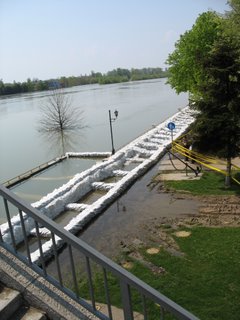 Efforts to create mini-locks by sandbagging (note the tree in the distance underwater)
 This home has been underwater for weeks. The windows you see are on the second story!
 If you didn't believe me that the windows are on the second story, look on the left of the home...that's a basketball hoop!
 I think the "Parking" sign should read "Mooring"


 Posts